Section Gravitas
Section Gravitas: Competitor Intelligence Platform
Background
Competitor research at Gravitas used to be highly manual.
For reports, campaign reviews, and pitch work, the team had to check competitor activity across platforms such as Facebook, Instagram, TikTok, YouTube, and LinkedIn. This often meant opening posts one by one, pulling screenshots from tools like Metricool, checking engagement manually, and then choosing which posts looked notable enough to include in a deck.
The process worked, but it was slow and fragmented. Competitor content, engagement numbers, campaign activity, creator posts, and analysis were scattered across different tools, exports, screenshots, and slides.
There was no central workspace where the team could review competitor posts, compare performance, tag content, and build analysis from the same source of truth.
Problem
The main issue was not just that competitor research took time.
The deeper problem was that the research process was difficult to structure and reuse.
Because much of the work depended on manual checking and screenshot selection, comparisons could become inconsistent. One strategist might choose posts based on engagement, another might choose based on campaign relevance, and another might choose based on visual interest.
This made it harder to answer important questions clearly:
- Which competitors were most active?
- Which posts performed best?
- Which platforms were they strongest on?
- Which creators or KOLs were they using?
- What campaign themes appeared repeatedly?
- Which content formats drove stronger engagement?
- How did competitor activity compare against the client’s own account?
Without a structured review layer, competitor analysis remained too dependent on manual interpretation.
Role
I designed and built Social Atlas as an internal competitor intelligence platform.
I was the sole builder across the core system: data ingestion, interface design, AI analysis layer, and Supabase backend.
The goal was to turn competitor research from a screenshot-heavy manual process into a structured workspace for reviewing, comparing, tagging, and analyzing competitor activity.
Goal
The goal was to give the team one place to understand competitor activity.
Instead of treating competitor research as a deck-making task, Social Atlas turns it into an intelligence workflow:
- Pull competitor content from multiple sources
- Store it in one structured database
- Review posts in a table-and-inspector interface
- Compare competitors side by side
- Use AI to generate first-pass summaries, sentiment, campaign labels, and content tags
- Export the findings into report-ready or review-ready formats
What I built
I built Social Atlas as a Vite and TypeScript web app backed by Supabase.
The platform ingests competitor content from sources such as Metricool, Apify, YouTube workflows, and local scraping workflows. The data is stored in a shared backend so competitor posts can be searched, filtered, reviewed, tagged, and compared from one place.
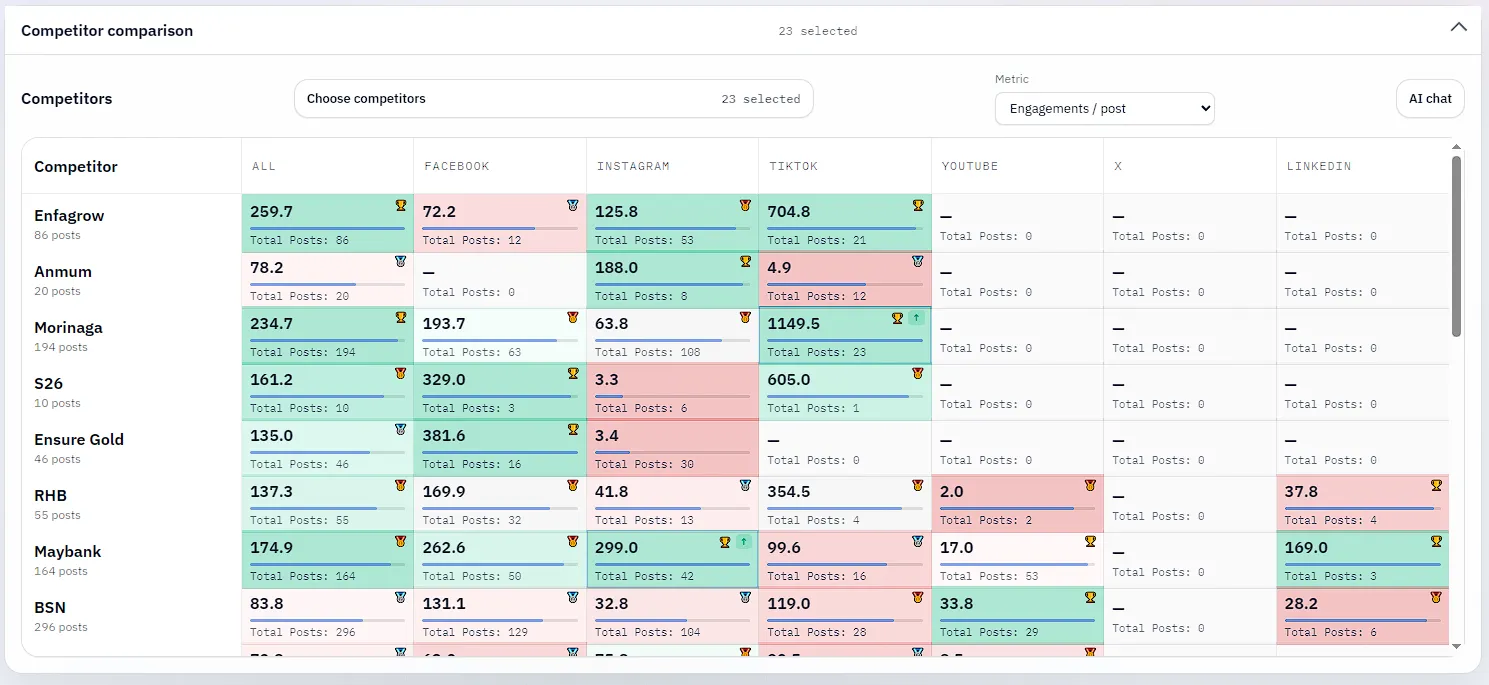
The interface includes a table-and-inspector view that allows users to review posts without jumping between multiple exports or tools. This makes it easier to inspect captions, platforms, engagement, media, campaign labels, and content notes in one workflow.
I also added an AI analysis layer using OpenRouter. This allows the platform to generate first-pass summaries, sentiment, campaign labels, and content tags. Analysts no longer need to start from a blank page. They can begin with a draft interpretation, then review and sharpen it.
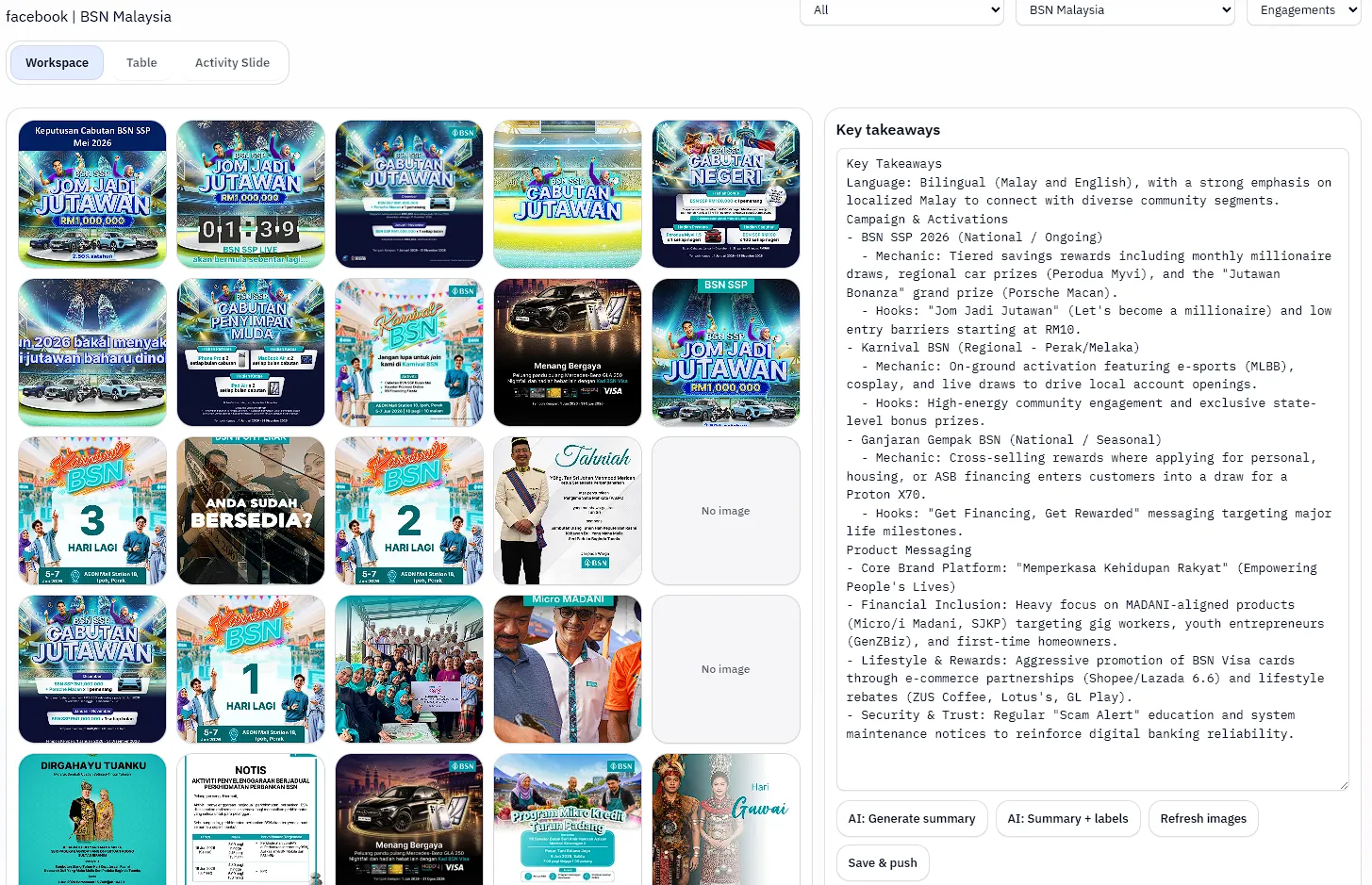
The database can be called by any AI agents through a Cloudflare worker so every member of the performance team could manipulate data using the AI agents or do a deeper analysis by asking the AI. See more here: Section Gravitas: Making the Performance Team Agentic
This then enable Social Atlas to also export activity review boards as standalone HTML files. This allows the team to review and categorize competitor activity outside the app when needed.
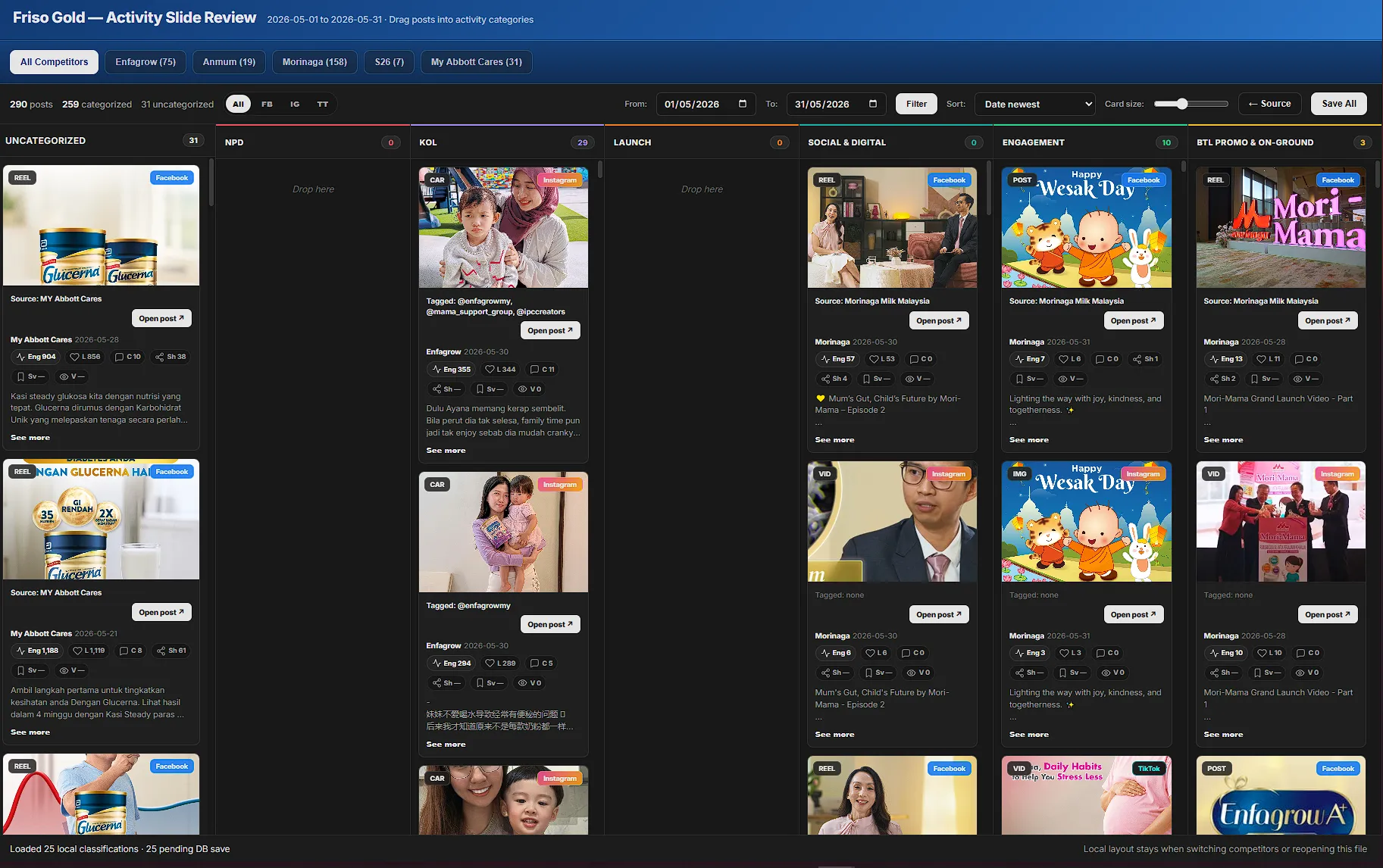
A live example is fgc.shazan.me**, used for Friso Gold’s May 2026 competitor activity review across Morinaga, Enfagrow, Anmum, S-26, and My Abbott Cares.
Result
Social Atlas gives the team a structured competitor intelligence layer.
Competitor research is no longer limited to scattered screenshots, separate exports, and manually selected examples. The team can now review competitor activity from a shared database, compare posts more systematically, and generate first-pass analysis through AI.
This improves both speed and quality.
The team can identify top posts, recurring campaign themes, active competitors, creator usage, engagement patterns, and platform differences more clearly. Instead of only asking “which posts should go into the deck?”, the team can ask better questions about what competitors are actually doing and why it matters.
Strategic Value
Social Atlas turns competitor research into a reusable intelligence asset.
Each review does not disappear into a one-off deck. Competitor content and analysis can be stored, searched, compared, and reused across future reports, campaign reviews, and pitch work.
The platform helps the team build a growing archive of competitor behaviour, making future analysis faster, more structured, and more evidence-based.