Section Gravitas
Section Gravitas: Making the Performance Team Agentic
Background
The Performance team previously used AI sparsely and mostly at an individual level.
Some people used AI for small tasks, but there was no shared operating system for how the team should use it. Workflows depended on each person’s habits, tools, prompts, local files, and access to different credentials.
This became a bigger issue after multiple changes in the team. The Head of Performance left, a planned manager also left, and for a period the Performance function had to continue with limited manpower. When new people joined, the challenge was no longer just whether I could use AI to work faster as an individual. The real question became: how do we make the whole Performance team more productive with AI?
Problem
The problem was not just a lack of AI usage. The problem was that AI usage was not systemized.
There were several bottlenecks:
- AI workflows were stuck at the individual level
- Skills and prompts were not reusable across the team
- Different people preferred different AI tools
- Credentials were scattered across services such as Metricool, Apify, databases, and other APIs
- New team members could not easily run existing workflows without knowing the full setup
- Internal automation risked becoming dependent on one person’s machine or memory
This made AI adoption fragile. It could help one person move faster, but it did not yet compound across the team.
Goal
The goal was to make the Performance team agentic at the team level, not just the individual level.
That meant creating a system where anyone in the team could use shared AI skills, regardless of whether they preferred Claude, Codex, OpenCode, or another coding agent.
The team needed reusable workflows, shared access patterns, and a safer way to handle credentials without copying secrets across machines.
What I built
I helped create a shared GitHub-based skills repository for the Performance team.
The idea is simple: the AI tool can change, but the skills should remain portable. Whether someone uses Claude, Codex, OpenCode, or another agent, they can pull the same skills from the repo and apply them to their own workflow.
This turns AI usage from isolated prompting into reusable team capability.
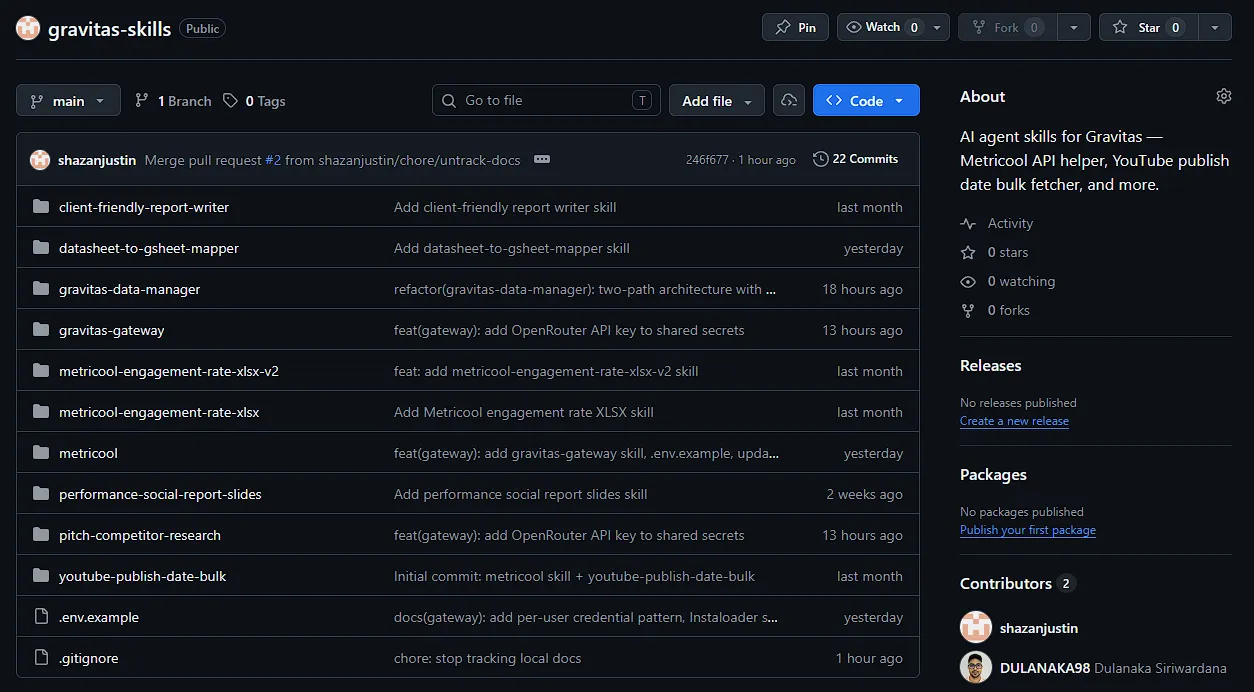
github.com/shazanjustin/gravitas-skills
I also helped create Gravitas Gateway, a shared access layer for team skills and secrets.
The team uses multiple tools and data sources, including Metricool, Apify, databases, Google Drive workflows, and other APIs. These often require API keys, tokens, or private credentials. Instead of making every team member remember or store every secret locally, we created a Cloudflare Worker that centralizes secret access behind one controlled gateway.
The workflow works like this:
- Skills live in a shared GitHub repository
- A team member uses Gravitas Gateway to access and download the relevant skills locally
- The gateway checks access through a single API key
- The API key unlocks access to the Cloudflare Worker
- The worker handles the underlying secrets for connected tools and services
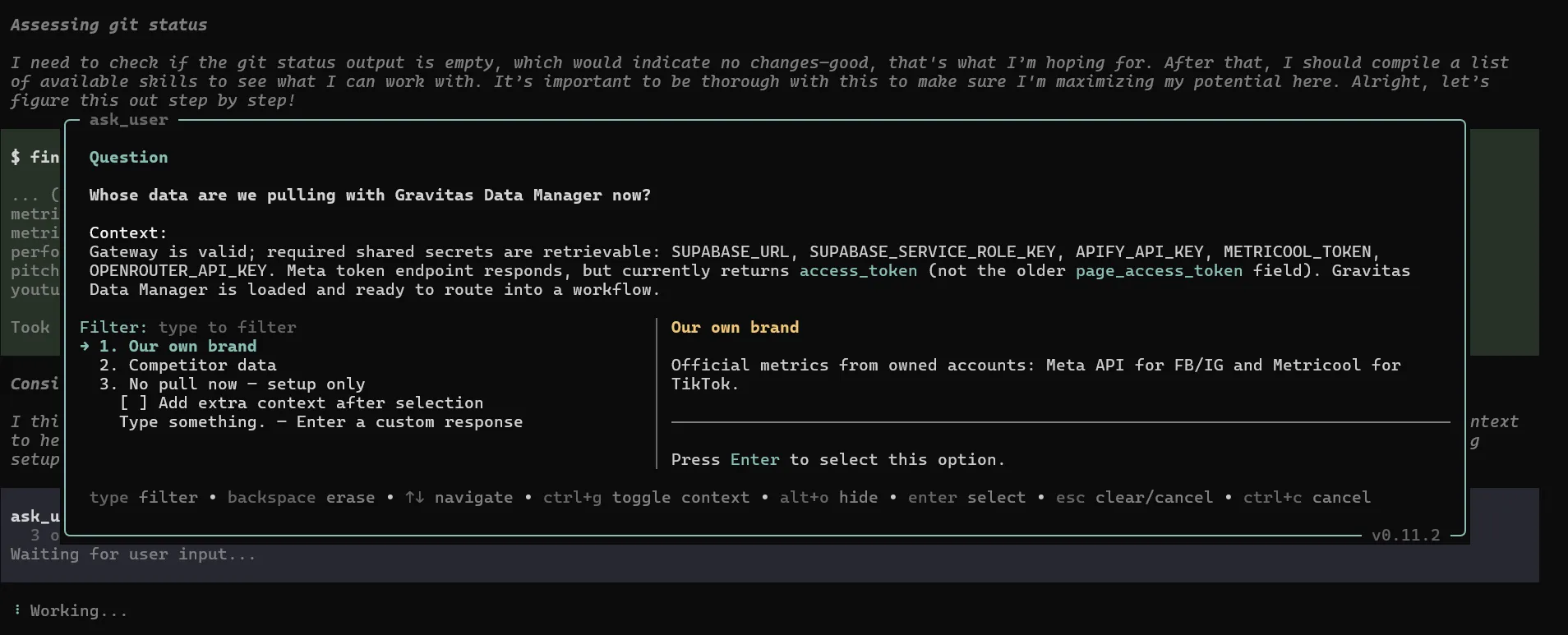
Accessing Gravitas Data Manager with Gravitas Gateway skill using pi as coding agent.
This means team members do not need to manage every individual secret themselves. They only need access to the gateway.
We also explored tools such as Composio to connect AI workflows with internal data sources, including Google Drive. This allows the team to move toward AI workflows that can interact with actual working files and internal knowledge, rather than operating only on manually pasted context.
Result
The Performance team is moving from individual AI usage toward shared AI infrastructure.
Instead of each person building isolated prompts and workflows, the team now has a foundation for reusable skills, shared automation, controlled credential access, and tool-agnostic AI workflows.
This makes onboarding easier, reduces dependency on one person’s setup, and allows AI workflows to compound across the team.